Comprehensive Simulation of 65 Nature-based Solutions Scenarios
• Climate - Environmental Quality - Health
The report includes collating and generating data in preparation for microclimate simulations of implemented NbS for thirteen cities, including five demonstration cities: Belfast, Breda, Budapest, Maribor, and Katowice, and seven partner cities: Prato, Pula, Antwerp, Passau, Vienna, Skopje, Patras, and Zaragoza. The report outlines the methodology for conducting microclimatic simulations to assess the effects of NbS, the urban heat island effect, and hotspots across all 13 cities (Section 4). The report then sets out the parameters to undertake 70 simulations, including at a city scale (Urban Heat Island (UHI), Hotspot analysis) and at a neighbourhood or street scale (setting parameters for simulating the base scenario, NbS scenario and thermal comfort) for the 13 cities (Section 5; Table 5.1). A more detailed case study is presented for the green corridor NbS implemented in Maribor. This includes the simulation of thermal comfort considerations for vulnerable groups. Further NbS simulation results for the UPSURGE demonstration sites and partner cities will be developed for academic publication.
UPSURGE demo and partner cities can use the document for cross-city learning of various NbS implemented to mitigate urban heat and floods. They can also use the simulation methodology to estimate the impact of NbS on a targeted group.
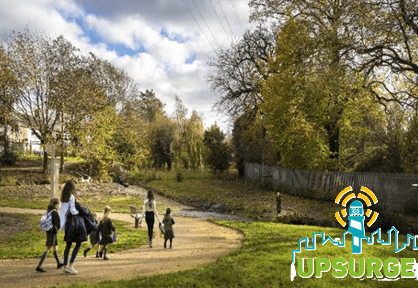
Image from Eastside Partnership Community Greenway
Publication date:



The UrbanByNature programme is funded by the Horizon 2020 Framework Programme of the European Union under Grant Agreements No. 730222 and No. 776604. It has received funding for an update by the Horizon Europe Programme under the Grant Agreement No 101003818. The sole responsibility for the content of this website lies within UrbanByNature and in no way reflects the views of the European Union.