Biodiversity’s Role in Resilient Communities: How Biodiversity improves health outcomes and creates more livable just cities

Cities around the world are navigating a convergence of pressures: intensifying climate impacts, rising heat and flooding risks, widening health inequalities, and growing demands on overstretched public services. At the same time, many urban residents remain disconnected from nature, and conventional urban management practices often prioritise order and control over ecological function. In this context, biodiversity offers not only environmental value but a strategic pathway to strengthen community resilience, reduce health risks, and create more liveable, equitable cities.
Against this backdrop, UrbanByNature hosted the third session of its series Biodiversity’s Role in Resilient Communities on 20 November 2025. The 90-minute webinar, Partnerships for Biodiversity & Equity: A Global Approach to Health, brought together practitioners from Ecuador, Spain and the United States to demonstrate how biodiversity can operate as essential urban infrastructure for health and wellbeing. The session was delivered in English with Spanish interpretation.
The first speaker, Nicolás Salmon (YES Innovation, Ecuador), explored the contradictions of Ecuadorian cities, situated in one of the world’s most biodiverse countries, yet often managed in ways that undermine ecological health. He described how routine practices, such as removing trees to maintain “tidy” sidewalks, erode urban ecosystems and public comfort. Salmon presented three strategies to reverse this trend:
- planning according to ecological landscape units
- making nature visible and meaningful in daily life
- and integrating natural elements wherever possible in public space.
Examples from Durán’s Cinco de Junio canal and the restoration ofEl Carmen lagoon illustrated how targeted interventions can transform environmental performance, microclimate conditions, and residents’ perceptions of what their neighbourhoods can become.
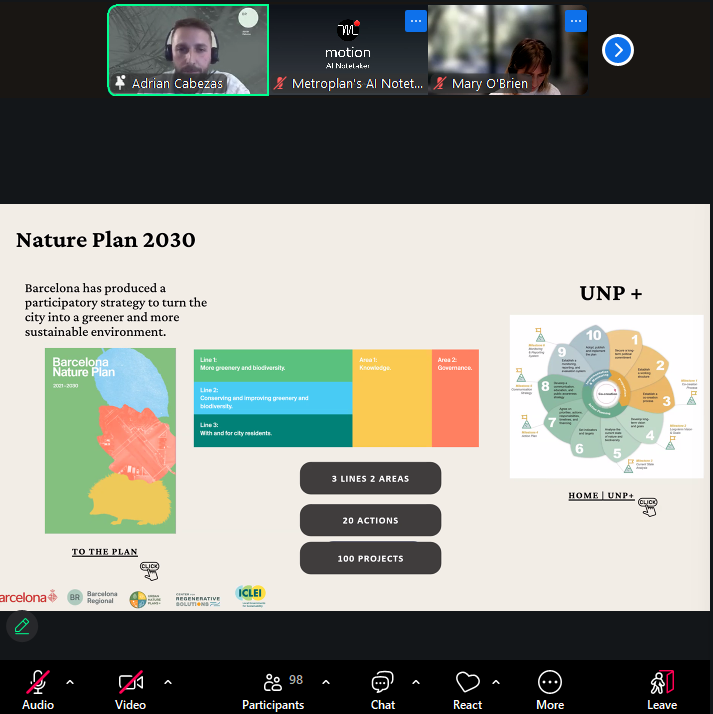
Adrián Cabezas (Barcelona Regional) provided a European perspective, highlighting Barcelona’s Nature Plan 2030 and its deliberate alignment of biodiversity, public health and social equity. The plan includes more than 100 projects and shifts the city toward ecological maintenance, banning herbicides and enhancing spontaneous vegetation. Cabezas emphasised that these measures are not cosmetic:
“We no longer treat biodiversity and health as separate priorities; they are fully integrated into how we design and manage the city.”
He also underscored the city’s equity commitment:
“A fair model of urban greenery means directing biodiversity to the places where people need it most.”
Initiatives such as social prescribing, biodiversity nodes, and Superblocks demonstrate how access to nature can be structurally embedded into urban life.
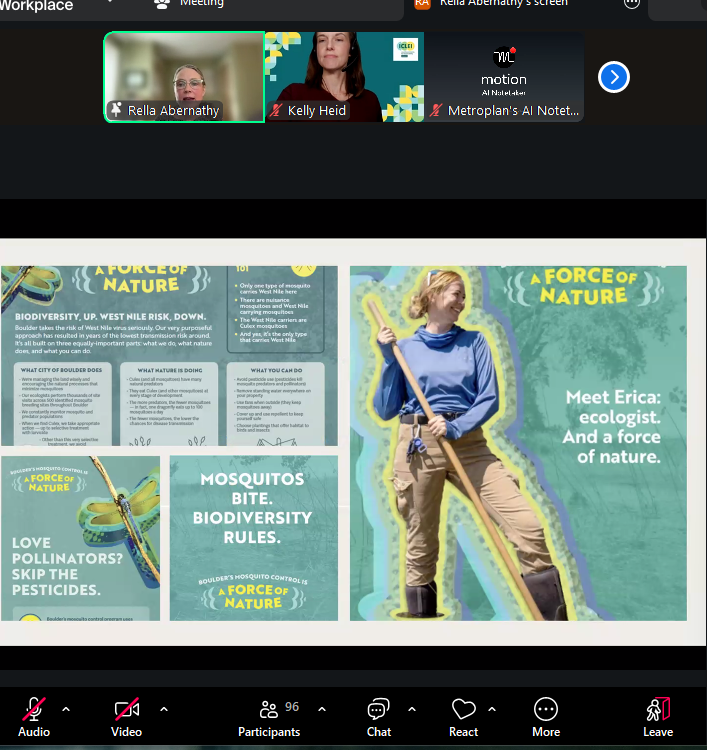
From Colorado, Rella Abernathy (City of Boulder) presented an ecosystem-based approach to reducing mosquito-borne disease risk. She highlighted the limitations of conventional adulticide spraying, noting its impacts on non-target species and ecosystem function. Boulder instead emphasises larval-stage control, habitat monitoring, and community education, recognising that most land is privately owned and requires public participation for biodiversity measures to be effective. Abernathy reinforced the broader message that healthy wetlands are essential for healthy communities.
During the discussion, speakers addressed a central question: How can cities make biodiversity requirements mandatory rather than optional? Barcelona shared examples from its metropolitan plan, which requires soil permeability and ecological criteria in urban development. Boulder described the use of updated landscape codes to promote native species while navigating the difficulty of mandating private behaviour. Ecuador highlighted the gap between ambitious plans and the municipal capacity needed to enforce them. As a commonality, this exchange underscored that regulatory frameworks, backed by public understanding, are critical for embedding biodiversity into long-term urban transformation.
Stay tuned for the session recording and for future modules on Biodiversity and Health.


The UrbanByNature programme is funded by the Horizon 2020 Framework Programme of the European Union under Grant Agreements No. 730222 and No. 776604. It has received funding for an update by the Horizon Europe Programme under the Grant Agreement No 101003818. The sole responsibility for the content of this website lies within UrbanByNature and in no way reflects the views of the European Union.